

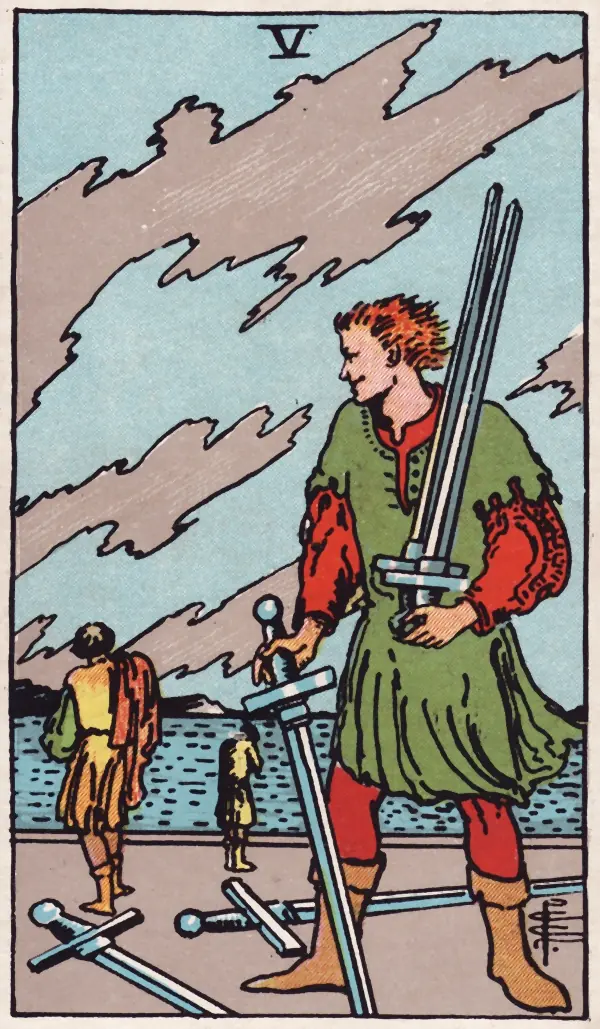
Folio 55
Suit of Swords
Five of Swords
Upright
conflict, · hollow victory, · pride
Winning the argument may cost the relationship. Ask whether this victory is worth it.
Reversed
reconciliation, · regret, · letting it go
The wish to make amends is surfacing. Lay down your weapons and talk.
Symbolism
The Five of Swords shows a man with a smirk, holding three swords while two more lie on the ground. In the background, two defeated figures walk away toward the sea under a sky of wind-torn clouds. In the 1909 art, he won, but he's left alone with the weapons: the victory emptied the field.
In general
The Five of Swords is the card of a hollow victory. It shows up when there's conflict, a clash of egos, arguments where someone has to win at any cost. It's about pride, words that wound, unfair competition and the price of being right. Sometimes it shows you winning in a way that drives people away; sometimes, losing to someone like that. Reversed, it's time to make peace, drop the fight or admit you were wrong.
Yes or no
In the Five of Swords, someone wins and loses at the same time: no. A win like this would cost too much. Reversed, the answer is maybe: the blades get picked up off the ground, and it depends on choosing peace over being right.
In love
In a love reading, the Five of Swords points to fights, wounded pride, or a standoff where no one backs down.
If you're in a relationship, it's a warning: winning the argument could mean losing the relationship. If you're single, it asks you to be wary of people who play games.
Reversed, it points to reconciliation, apologizing or putting a fight behind you.
As feelings
As feelings, the Five of Swords means hurt mixed with pride: this person may be resentful and on the defensive. Reversed, it shows a wish to make peace.
At work
At work, the Five of Swords often points to unfair competition, gossip, power struggles or a hostile environment. Reversed, it shows conflicts getting resolved.
With money
With money, the Five of Swords warns against unfair deals and fights over money. Reversed, it's time to negotiate.
In family and friendship
In family and friendship, the Five of Swords brings arguments and falling-outs over pride. Reversed, it shows reconciliation is possible.
On the personal path
On a personal level, the Five of Swords asks you to consider: is this fight worth winning? Reversed, it invites you to let go of your pride.
Advice
As advice, the Five of Swords says: pick your battles. Not every win is worth what it costs.
In the Celtic Cross positions
- The Present: there's a conflict, a dispute or a win that leaves a bitter taste.
- The Challenge: the obstacle is pride, yours or someone else's.
- The Crown: you want to win, or to prove you're right.
- The Foundation: underneath the question is an old resentment.
- The Recent Past: a recent fight or defeat shaped the situation.
- The Near Future: a dispute is coming; it's worth choosing peace.
- Yourself: you may be more combative than is helpful.
- Your Environment: there's competition, gossip or hostility around you.
- Hopes and Fears: you want to win, and you're afraid of being humiliated.
- The Outcome: this points to a conflict that only resolves with humility.
Frequently asked questions
Is the Five of Swords a bad card?
It's a hard card, about conflict and empty victories. The way out is letting go of pride.
What does the Five of Swords reversed mean?
Reversed, it points to reconciliation, dropping a fight, apologizing or learning from a defeat.
Is the Five of Swords a yes or no card?
Upright, it's a no. Reversed, it's a maybe.
See also the Four of Swords, which comes before it, the Six of Swords, the next step, and the Five of Wands, another card of conflict.