Folio 54
Suit of Swords
Four of Swords
Upright
rest, · recovery, · contemplation
A pause to recover. Rest is part of the journey too.
Reversed
restlessness, · burnout, · re-emerging
Your body asks for rest and you push on. Or rest is over and it is time to return.
Symbolism
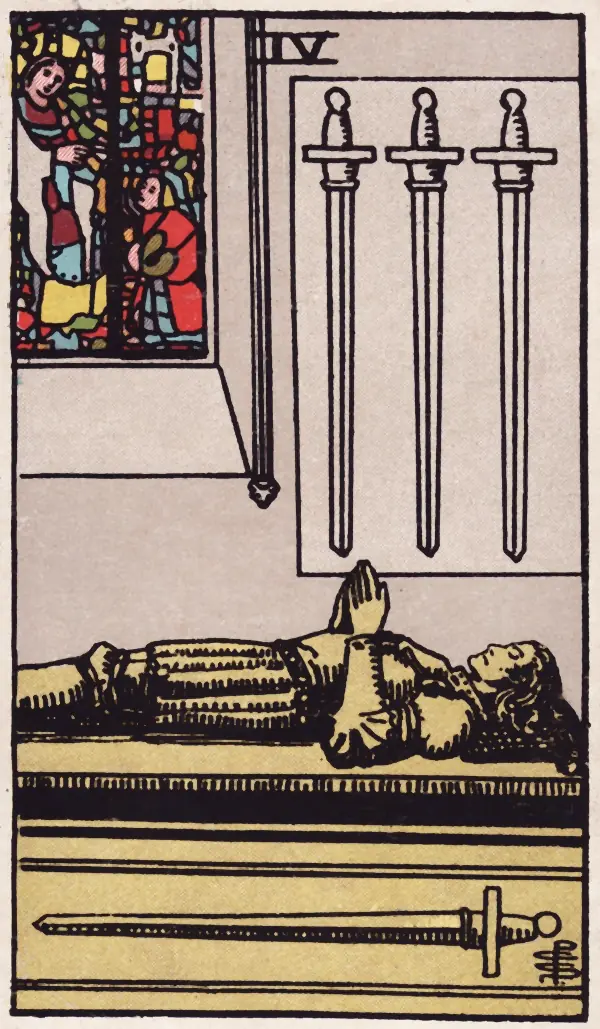
The Four of Swords shows the effigy of a knight lying on a tomb, hands joined in prayer. One sword lies beneath him and three more hang on the wall above. Beside him is a stained-glass window. In the 1909 art, this isn't death: it's rest, the stillness you need after a battle.
In general
The Four of Swords is the card of rest. It shows up when your mind and body need a break: after a conflict, a heartache or a stretch of hard work. It's about recovery, quiet, meditation and gathering your strength before the next step. Reversed, it shows rest that's denied or cut short: burnout, sleepless nights, going back into the fight too soon, or a pause ending and action starting again.
Yes or no
The Four of Swords rests in silence: maybe, but after rest. Now is the time to recover, not to act. Reversed, the answer is no, not for now: exhaustion is still making your decisions.
In love
In a love reading, the Four of Swords points to a pause: time to think, some space after a fight, or a period of not looking for anyone.
If you're in a relationship, it asks for rest and calm before any hard conversations. If you're single, it shows a time of recovery.
Reversed, it points to opening up again, or rushing past the time you need to heal.
As feelings
As feelings, the Four of Swords means someone who needs space and quiet to understand what they feel. Reversed, it shows someone ready to get back in touch.
At work
At work, the Four of Swords often points to a vacation, a strategic pause or the need to avoid burnout. Reversed, it warns against overwork.
With money
With money, the Four of Swords asks you not to make big decisions while you're tired or stressed. Reversed, it's time to act again.
In family and friendship
In family and friendship, the Four of Swords brings a need for space and quiet. Reversed, it shows you reconnecting with people.
On the personal path
On a personal level, the Four of Swords asks you to truly rest: sleep, meditate, unplug. A rested mind makes better decisions. Reversed, it shows your body asking for a break while you keep pushing.
Advice
As advice, the Four of Swords says: rest before you move on. The pause is part of the path.
In the Celtic Cross positions
- The Present: you need a pause to recover.
- The Challenge: the obstacle is exhaustion, or a hard time stopping.
- The Crown: you want peace and rest.
- The Foundation: underneath the question is built-up exhaustion.
- The Recent Past: a period of struggle or tension is behind you.
- The Near Future: a time of rest and reflection is coming.
- Yourself: you're withdrawn and turned inward.
- Your Environment: there's quiet around you, or a need to step away.
- Hopes and Fears: you want peace, and you're afraid of falling behind.
- The Outcome: this points to recovery, after a pause.
Frequently asked questions
Is the Four of Swords a good card?
It's a card of pause and healing. It asks for rest, which is often exactly what's missing.
What does the Four of Swords reversed mean?
Reversed, it points to burnout, rest that gets interrupted, or a pause ending and action starting again.
Is the Four of Swords a yes or no card?
Upright, it's a maybe, but after rest. Reversed, it's a no, for now.
See also the Three of Swords, which comes before it, the Five of Swords, the next step, and The Hanged Man, another card of pause.