
Folio 27
Suit of Wands
Five of Wands
Upright
conflict, · competition, · differing views
Many voices competing for space. Friction can be creative if there is listening.
Reversed
avoiding conflict, · truce, · inner tension
You are avoiding a necessary confrontation, or a truce is near. Choose your battles.
Symbolism
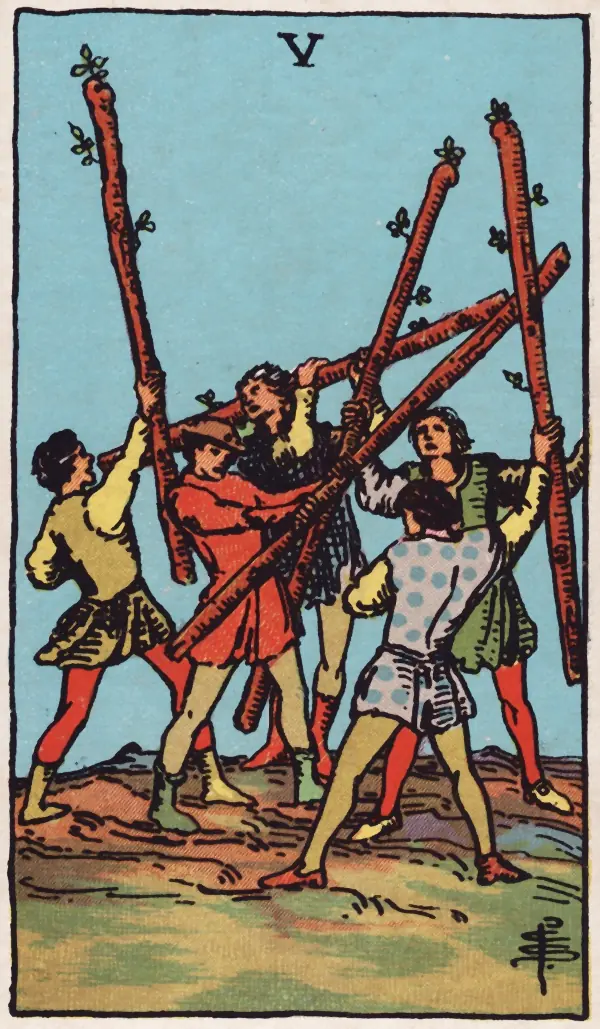
The Five of Wands shows five young men waving staffs at each other, with no order and no clear target. No one seems to be getting hurt, but no one is building anything either. In the 1909 art, it's a clash of energy: everyone wants their own staff on top, and all it produces is noise.
In general
The Five of Wands is the card of friction. It shows up when there's competition, arguing, clashing egos or too many opinions pulling in different directions. It's about rivalry, disorder and energy spent fighting instead of building. Sometimes it's healthy competition that pushes you to grow; often, it's just draining. Reversed, it shows the fight winding down: a search for agreement or, the opposite, a conflict that hides instead of getting resolved.
Yes or no
In the Five of Wands, everyone fights and no one builds: no, not like this. There's too much strife for things to move. Reversed, the answer is maybe: the staffs are starting to come down, and it depends on trading the quarrel for an agreement.
In love
In a love reading, the Five of Wands points to arguments, ego clashes or competition: small, repeated fights, or more than one person in the picture.
If you're in a relationship, it asks you to notice the arguments that never resolve anything. If you're single, it can point to rivalry, or someone else interested in the same person.
Reversed, it points to a truce, conversations that cool things down, or avoided conflicts that are still there.
As feelings
As feelings, the Five of Wands means something restless: this person feels attraction, but friction too, and things may swing between desire and arguing. Reversed, it shows a wish to make peace.
At work
At work, the Five of Wands often points to competition, chaotic meetings, team conflict, or too many people trying to lead. Reversed, it shows agreements taking shape, or conflicts being swept under the rug.
With money
With money, the Five of Wands calls for caution with disputes, fierce competition and decisions made in the heat of an argument. Reversed, it's time to negotiate.
In family and friendship
In family and friendship, the Five of Wands brings bickering, petty fights and clashing opinions. Reversed, it shows a chance for a conversation that finally ends the fight.
On the personal path
On a personal level, the Five of Wands asks you to pick your battles: not every argument deserves your energy. Reversed, it shows the peace that comes from letting go of needing to be right.
Advice
As advice, the Five of Wands says: turn the fight into teamwork, or walk away from it.
In the Celtic Cross positions
- The Present: there's friction, competition or too many voices at once.
- The Challenge: the obstacle is clashing interests, or your own ego.
- The Crown: you want to prove yourself and win the argument.
- The Foundation: underneath the question are old rivalries or tensions.
- The Recent Past: a recent argument or competition shaped the situation.
- The Near Future: a stretch of friction is coming; it can be short if people talk.
- Yourself: you may be more competitive than you need to be.
- Your Environment: there are disputes, strong opinions and not much order around you.
- Hopes and Fears: you want to win, and you're afraid of being left behind.
- The Outcome: this points to conflict, unless there's an agreement.
Frequently asked questions
Is the Five of Wands a bad card?
It's a card of friction, but not disaster. It usually shows small conflicts that can turn into growth if people actually talk.
What does the Five of Wands reversed mean?
Reversed, it points to the end of a conflict, a search for agreement, or dodging a fight that really needs to happen.
Is the Five of Wands a yes or no card?
Upright, it's a no. Reversed, it's a maybe.
See also the Four of Wands, which comes before it, the Six of Wands, the next step, and the Five of Swords, another card of conflict.