

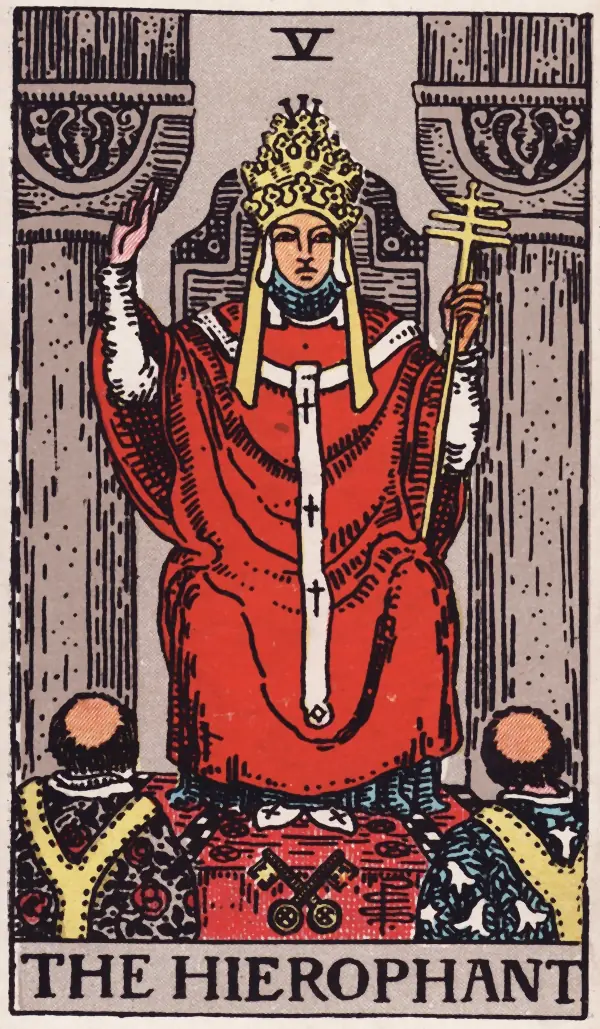
V · Folio 6
Major Arcana · V
The Hierophant
Upright
tradition, · teaching, · belonging
Established paths and good teachers matter now. Learn from those who walked before you.
Reversed
rebellion, · dogma, · a path of your own
Rules that no longer fit ask to be questioned. Challenge dogma and find a faith of your own.
Symbolism
The Hierophant sits between two gray pillars, wearing a triple crown. His right hand is raised in blessing, two fingers pointing to the sky; his left holds a staff topped with a triple cross. At his feet lie two crossed keys, one gold and one silver, and two followers kneel before him, one in a robe embroidered with roses, the other with lilies. In the 1909 art, he is the bridge between the sacred and ordinary people: knowledge handed down from teacher to student.
In general
The Hierophant is the card of tradition. It shows up when the wisest way forward is the one that's already been mapped: learning from someone who knows, following a proven method, honoring a commitment, asking for guidance. It's about institutions, rituals, shared values and belonging to a group. It's the card of the teacher, the school, religion and formal marriage. Reversed, it points to questioning the rules: wanting to do things your own way, breaking with dogma, or feeling boxed in by a structure that no longer makes sense.
Yes or no
The Hierophant blesses the well-trodden road: yes, the traditional way. It helps to listen to those who have walked it before. Reversed, the answer is maybe: the usual keys won't open this door, so you may need to find a path of your own.
In love
In a love reading, The Hierophant points to serious commitment and shared values: making things official, getting married, meeting the family, building something within the traditions that matter to both of you.
If you're in a relationship, it speaks of taking a formal step, or of getting your beliefs and life plans on the same page. If you're single, The Hierophant can point to someone you meet through a group, a community, a class or your own family.
Reversed, it points to an unconventional relationship, a clash of values, or pressure to follow a script that doesn't fit the two of you.
As feelings
As feelings, The Hierophant means respect and serious intentions: this person sees you as someone to build something lasting with, and may be fairly traditional in how they show it. Reversed, the feelings are held back by rules, guilt or worry about what other people will think.
At work
At work, The Hierophant often points to education, training, mentorship and institutions: a course, a certification, a job at a large or established company, or a more experienced colleague who takes you under their wing. Reversed, it shows friction with bureaucracy, the urge to innovate against "the way it's always been done," or a more independent path.
With money
With money, The Hierophant favors safe, proven routes: professional advice, conservative investments, sticking with what already works. Reversed, it can point to an unconventional choice, one that calls for more research before you take the risk.
In family and friendship
In family and friendship, The Hierophant brings traditions, celebrations and values passed down through the generations. It can also be the person everyone looks up to. Reversed, it shows a conflict between what your family expects and what you want, or the need to start traditions of your own.
On the personal path
On a personal level, The Hierophant asks you to find a teacher, a course of study or a practice that gives your search some structure. Not everything has to be invented from scratch. Reversed, it invites you to question what you were taught and keep only what still rings true.
Advice
As advice, The Hierophant says: learn from those who came before you, but never stop asking why things are the way they are.
In the Celtic Cross positions
- The Present: this situation revolves around rules, commitments or an institution.
- The Challenge: the obstacle is rigid rules, or a reluctance to ask for guidance.
- The Crown: you're looking for an established path, approval or a sense of belonging.
- The Foundation: underneath the question are values you learned early on that still guide your choices.
- The Recent Past: a lesson, a commitment or a ritual set this situation in motion.
- The Near Future: guidance is coming, whether a course, a formal commitment or someone with more experience.
- Yourself: you're trying to do things the right way.
- Your Environment: there are traditions, hierarchies or group expectations around you.
- Hopes and Fears: you want to belong, and you're afraid of being judged for going off script.
- The Outcome: this points to a commitment, or to a lesson that gives you solid ground for what comes next.
Frequently asked questions
Is The Hierophant a good card?
In most readings, yes. It's about guidance, commitment and solid values. It only weighs on you when what you really need is the freedom to take a different path.
What does The Hierophant reversed mean?
The Hierophant reversed points to breaking the rules, questioning tradition, conflict with institutions or family, or a more independent path.
Is The Hierophant a yes or no card?
Upright, The Hierophant is a yes, the traditional way. Reversed, it's a maybe.
What do the keys at The Hierophant's feet mean?
They're the keys to heaven and earth, or to spiritual and practical knowledge. They show that he holds wisdom that can be taught to anyone who comes to him.
See also The Emperor, who comes before him, The Lovers, the next step, and The High Priestess, the other face of spiritual knowledge.