
Folio 32
Suit of Wands
Ten of Wands
Upright
overload, · responsibility, · strain
You are carrying more than you should. Not every burden is yours.
Reversed
relief, · delegating, · putting the load down
It is time to put part of the load down. Delegating is also strength.
Symbolism
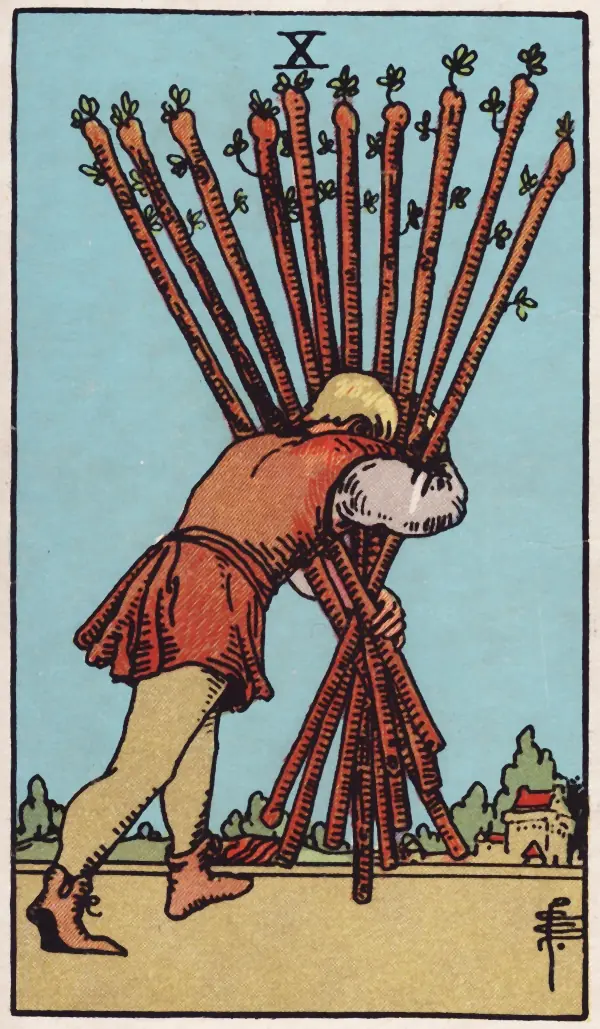
The Ten of Wands shows a man bent over, hugging a bundle of ten wands so big it blocks his view. He's walking toward a house in the distance. In the 1909 art, he's almost there, but he's carrying more than he can see past.
In general
The Ten of Wands is the card of overload. It shows up when you've taken on too much: work, family, other people's problems, commitments that kept piling up. It's about effort, duty and the exhaustion of carrying everything alone. Success may be close, but the weight drains the joy out of the journey. Reversed, it shows relief beginning: putting down what isn't yours, delegating, saying no, or the opposite, collapsing because you just can't anymore.
Yes or no
The Ten of Wands carries more staffs than it can bear: no. Taking on this weight as well would only slow you down. Reversed, the answer is maybe: it depends on sharing, or dropping, what isn't yours to carry.
In love
In a love reading, the Ten of Wands points to a heavy relationship: one person carrying everything, responsibilities crowding out the fun, or love taking a back seat.
If you're in a relationship, it asks you to share the load. If you're single, it suggests you may not have room for anyone right now.
Reversed, it points to letting go of a relationship that only weighed you down, or finally asking your partner for help.
As feelings
As feelings, the Ten of Wands means someone who likes you but is too overloaded to give you their attention. Reversed, it shows someone who feels the relationship as an obligation.
At work
At work, the Ten of Wands often points to too many tasks, deadlines piling up and a hard time delegating. Reversed, it shows a chance to redistribute the work, or the risk of burnout.
With money
With money, the Ten of Wands points to too many obligations and bills at once. Reversed, it asks you to cut commitments you can no longer sustain.
In family and friendship
In family and friendship, the Ten of Wands brings the person who looks after everyone and forgets about themselves. Reversed, it's time to ask for help.
On the personal path
On a personal level, the Ten of Wands asks you to look at what you're carrying and decide what can be dropped, shared or put off. Reversed, it shows you've already started letting go.
Advice
As advice, the Ten of Wands says: don't carry alone what could be shared.
In the Celtic Cross positions
- The Present: you're carrying more than you can handle.
- The Challenge: the obstacle is overload, or a hard time delegating.
- The Crown: you want to handle everything, maybe more than is possible.
- The Foundation: underneath the question is a sense of duty that won't let you put anything down.
- The Recent Past: responsibilities have been piling up until now.
- The Near Future: a moment is coming to decide what to let go of.
- Yourself: you're hardworking, but worn out.
- Your Environment: there are a lot of demands around you and not much help.
- Hopes and Fears: you want to get it all done, and you're afraid of collapsing.
- The Outcome: this points to relief, if the load gets shared.
Frequently asked questions
Is the Ten of Wands a bad card?
It's a card of burden and fatigue, but also the end of a cycle: the house is close. The warning is not to carry it all alone.
What does the Ten of Wands reversed mean?
Reversed, it points to putting burdens down, delegating and freeing yourself from responsibilities, or to collapsing from doing too much.
Is the Ten of Wands a yes or no card?
Upright, it's a no. Reversed, it's a maybe.
See also the Nine of Wands, which comes before it, the Page of Wands, who brings a fresh start to the suit, and the Ten of Swords, another ending.