Folio 60
Suit of Swords
Ten of Swords
Upright
painful ending, · rock bottom, · conclusion
Something has come to an end, and from here the only way is up. Dawn is already breaking on the horizon.
Reversed
recovery, · survival, · a slow restart
You are getting up slowly. The worst is behind you.
Symbolism
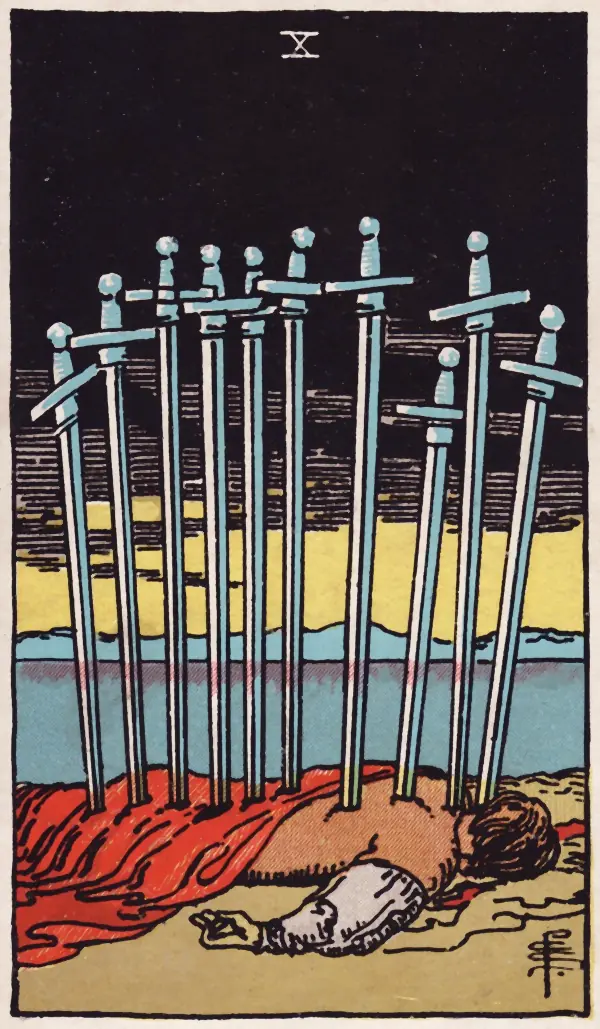
The Ten of Swords shows a figure lying face down with ten swords in their back and a red cloth draped over the body. The sky above is black, but on the horizon, over calm water, day is breaking in shades of gold. In the 1909 art, it's the lowest point possible, and that's exactly why there's nowhere to go but up.
In general
The Ten of Swords is the card of a final ending. It shows up when something hits rock bottom: a betrayal, a defeat, the end of a situation that's been hurting for a while. It's about exhaustion, pain and accepting that it's over. But it's also about relief: the worst has already happened, and dawn is on the horizon. Reversed, it shows recovery beginning: getting back up little by little, or the opposite, resisting an ending that's already happened.
Yes or no
The Ten of Swords is the end of the line: no. But look at the horizon, where day is already breaking. Reversed, the answer is maybe: the worst is over, and recovery comes in small steps.
In love
In a love reading, the Ten of Swords points to a clear ending: a breakup, a betrayal, or a relationship that has reached its limit.
If you're in a relationship, it asks you to look honestly at what can no longer hold. If you're single, it shows the end of a painful cycle and the start of recovery.
Reversed, it points to healing, getting back on your feet after a letdown, or holding on to something that's already over.
As feelings
As feelings, the Ten of Swords means someone who's emotionally drained and feels the story has ended. Reversed, it shows someone slowly recovering.
At work
At work, the Ten of Swords often points to a job or project ending, a defeat or burnout. Reversed, it shows rebuilding.
With money
With money, the Ten of Swords points to a hard moment, maybe the worst, from which you can rebuild. Reversed, it shows things starting to improve.
In family and friendship
In family and friendship, the Ten of Swords brings falling-outs or disappointments. Reversed, it shows people coming back together and healing.
On the personal path
On a personal level, the Ten of Swords asks you to accept that something is over and give yourself time to rest before starting again. Reversed, it shows you're already getting back up.
Advice
As advice, the Ten of Swords says: accept the ending. Dawn only comes after the night.
In the Celtic Cross positions
- The Present: something has ended, or hit its lowest point.
- The Challenge: the obstacle is accepting that it's over.
- The Crown: you want to close a painful chapter.
- The Foundation: underneath the question is a wound or a betrayal.
- The Recent Past: a painful ending just happened.
- The Near Future: something is about to close, followed by relief.
- Yourself: you're worn out, but you have a chance to start over.
- Your Environment: there are situations around you that have reached their limit.
- Hopes and Fears: you want it all to be over, and you're afraid of what comes next.
- The Outcome: this points to the end of a cycle and a new dawn.
Frequently asked questions
Is the Ten of Swords a bad card?
It's one of the toughest cards in the tarot, but it carries hope: the worst is behind you, and day is breaking.
What does the Ten of Swords reversed mean?
Reversed, it points to recovery, getting back up, or resisting an ending that has already happened.
Is the Ten of Swords a yes or no card?
Upright, it's a no. Reversed, it's a maybe.
See also the Nine of Swords, which comes before it, the Page of Swords, who brings a fresh start to the suit, and Death, another card of endings.