XIII · Folio 14
Major Arcana · XIII
Death
Upright
endings, · transformation, · renewal
One chapter closes so another can open. Let go of what has already served its purpose.
Reversed
clinging, · fear of change, · delayed transition
Resisting the ending prolongs the pain. Change has already begun; let yourself move through it.
Symbolism
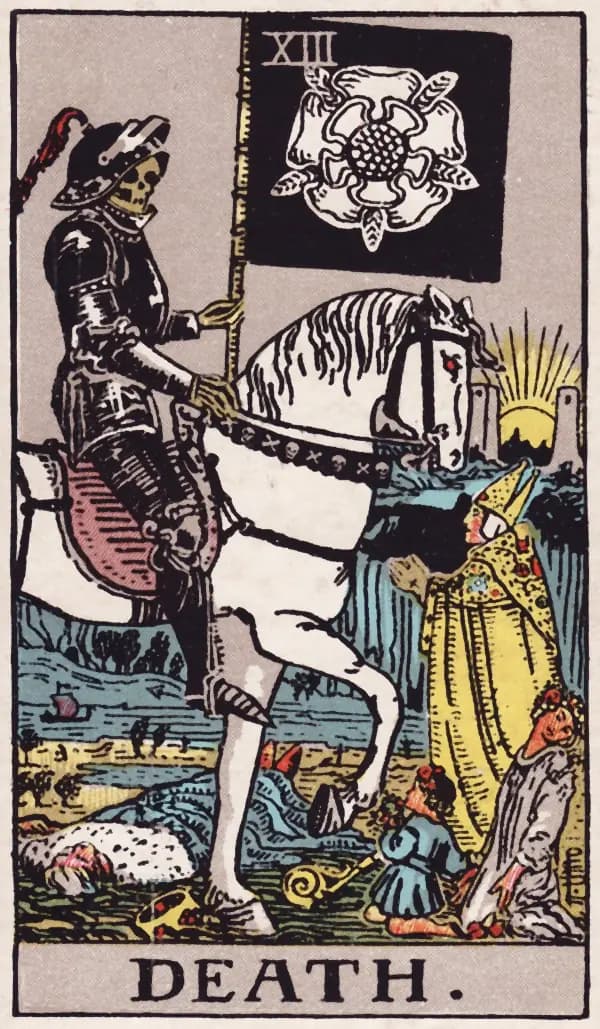
Death shows a skeleton in black armor riding a white horse and carrying a black banner marked with a white rose. A king already lies fallen in its path, while a bishop, a young woman and a child each meet it in their own way. In the background, between two towers, the sun is rising. In the 1909 art, Death comes for everyone alike, and the day keeps dawning after it has passed.
In general
Death is the card of endings. It almost never means physical death: it shows up when a phase of life, a relationship, a job or an old version of you is coming to a close, and something new can only begin once it's gone. This is a card of deep, unavoidable change, and it asks you to let go rather than hold on. Reversed, Death points to resistance: a chapter that's already over, but that you're still trying to keep alive.
Yes or no
Death closes a cycle: no, not as things stand. Something has to end so that something else can begin. Reversed, the answer is maybe: change is knocking, but you haven't opened the door yet.
In love
In a love reading, Death points to transformation: the end of a phase in the relationship, the end of the relationship itself, or a deep change in the way you love.
If you're in a relationship, it may mean the relationship has to let its old form die in order to be reborn in a new one. If you're single, Death asks you to finally let go of a past love, so the next one has room to arrive.
Reversed, Death shows an attachment to something that's already over: holding on to a relationship that has ended on the inside, or being unable to turn the page.
As feelings
As feelings, Death means something has changed deeply in how this person feels. It may be an ending, but it may also be a transformation: a feeling that's turning into something else. Reversed, it shows someone stuck in old feelings and struggling to move on.
At work
At work, Death often points to the end of a chapter: a job that ends, a role that changes, a project that wraps up. It clears the way for something that fits who you are now. Reversed, it shows stagnation: staying somewhere that no longer makes sense because you're afraid of what's next.
With money
With money, Death asks you to drop habits and commitments that no longer serve you: old debts, spending that has become automatic, an income stream that's drying up. Reversed, it shows how hard it is to change a money pattern you already know has to change.
In family and friendship
In family and friendship, Death points to changes in close relationships: a friendship that ends, a family dynamic that shifts, someone who drifts away. Reversed, it shows relationships kept going out of obligation that no longer nourish anyone.
On the personal path
On a personal level, Death asks you to let an old version of yourself die: a habit, a belief, an identity you've outgrown. It isn't loss; it's shedding a skin. Reversed, it shows fear of change, and how exhausting it is to cling to the past.
Advice
As advice, Death says: let go of what has already ended, so that what comes next has a place to land.
In the Celtic Cross positions
- The Present: a chapter is closing, and the real issue is accepting that it's over.
- The Challenge: the obstacle is resisting a change that has already begun.
- The Crown: you're after a deep transformation, a true fresh start.
- The Foundation: underneath the question is an ending you haven't fully processed.
- The Recent Past: something ended not long ago, and you can still feel it.
- The Near Future: a closure is coming, and it will make way for something new.
- Yourself: you're in the middle of a transformation, leaving an old self behind.
- Your Environment: changes and goodbyes around you are affecting the situation.
- Hopes and Fears: the fear of loss and the wish for change, which are often the same thing.
- The Outcome: this points to one cycle ending and another beginning.
Frequently asked questions
Does the Death card mean death?
Almost never. In tarot, Death stands for symbolic endings: a phase of life, a relationship, a way of living. It's a card of transformation, not of physical death.
What does Death reversed mean?
Death reversed points to resistance to change: a chapter that's over but still being dragged out, or a transformation that's stalled.
Is Death a yes or no card?
Upright, Death is a no, at least as things stand. Reversed, it's a maybe.
Is Death a bad card?
No. It can hurt, because it's about endings, but it's one of the most transformative cards in the deck: what ends makes room for what needs to be born.
See also The Tower, the other great card of change, and The Fool, the card of starting over.